20/10/2026 16:27
Can the Bot Promise a Repair? Telegram Chatbot Boundaries for Cambodian Fan Shops

A useful fan-repair demonstration can encourage viewers to message your shop while your technician is busy. An automated assistant might collect the first details, but a confident reply can create trouble if it promises a repair price, replacement part or pickup time that nobody checked. For Cambodian shops promoting their work through Telegram, the practical question is where automation should stop. This workflow explains how to define that boundary, restrict the conversations a connected bot can handle and rehearse the handoff to a person. It also explains why an SMM-panel service record cannot establish whether your enquiry process works.
1. Start with one narrow job for the assistant
Consider a hypothetical fan-repair shop in Phnom Penh that publishes demonstrations of completed work. Its owner answers messages between counter visits, while a technician examines appliances. After a new promotional post, customers may ask about several different fan models. The initial problem is incomplete enquiries: a photo without a question, a question without a model, or a request for collection without a location.
Give the assistant a written purpose: collect enough information for a staff member to decide the next step. That could mean asking for an exterior photo, the model if known and a short description of the problem. Keep diagnosis, repair acceptance, prices and appointment confirmation with staff. If most messages need individual judgement immediately, a person using prepared replies may be more suitable than a bot. Automation should solve an observed bottleneck, not become another task to supervise.
2. Separate Telegram's connection features from the bot's abilities
Telegram's Introducing Telegram Business page describes connecting bots that process and answer messages on an account's behalf, with controls over which chats they can access. The current Connected business bots documentation also describes permissions and controls for pausing a bot in a particular conversation. These platform features establish access and control; they do not establish that a particular bot understands repairs, Khmer voice messages or your stock.
Before choosing an assistant, ask its provider to demonstrate your actual enquiry sequence. Find out whether it uses approved responses, generates answers, stores message content or sends information to another service. Ask how staff take over and what happens when the provider is unavailable. Treat photo interpretation, language support, internal alerts and enquiry summaries as capabilities to verify. Do not assume that connecting a bot automatically supplies any of them. Use the official sources listed below to distinguish Telegram functionality from a provider's promises.
3. Decide which conversations belong inside the boundary
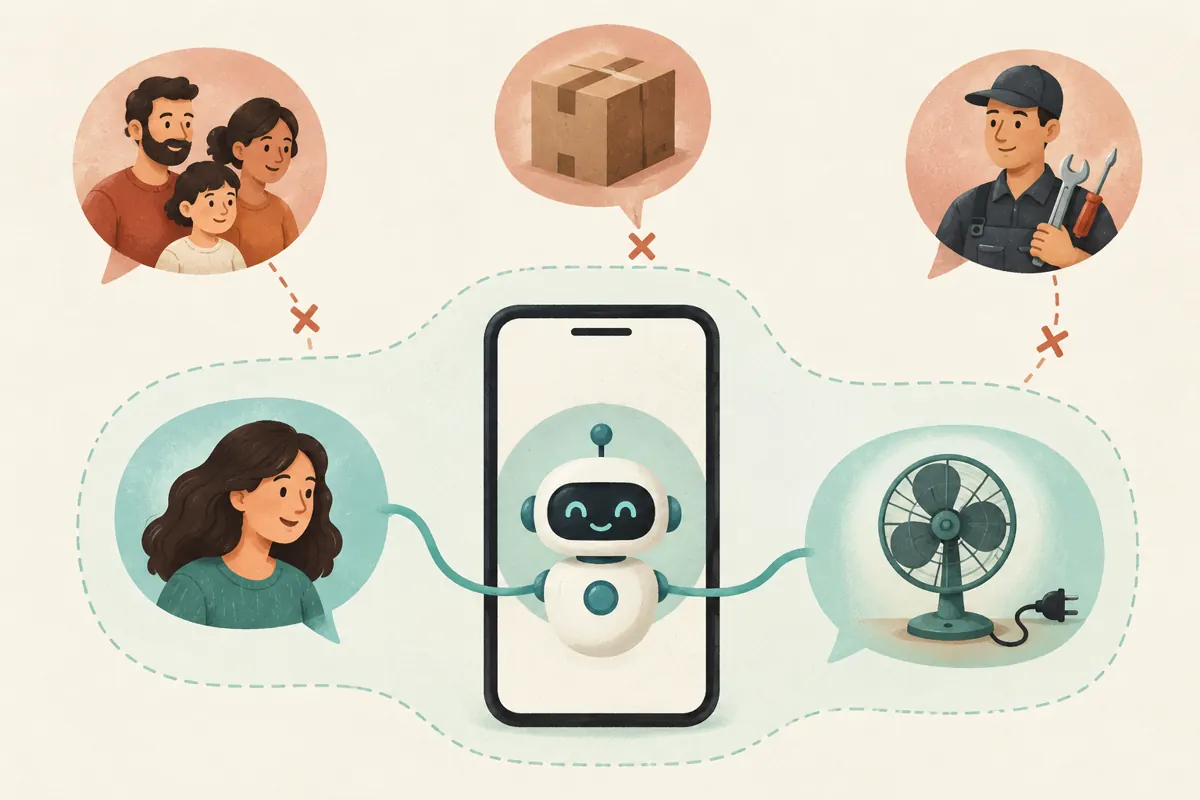
An owner's account may contain customer enquiries alongside family messages, supplier discussions and conversations with technicians. Write down which of these the assistant actually needs. For an initial trial, select a limited set of suitable test conversations where the available controls permit it. Expand access only after checking the result. Telegram describes recipient choices such as new chats, contacts and exclusions, but those categories need business interpretation.
A new chat is not necessarily a new customer. A supplier using a different account may appear for the first time, while a genuine customer may already be saved as a contact. Check these exceptions rather than assuming a category perfectly separates business roles. Review access settings with the account owner, then test both an included and an excluded conversation. A successful customer reply proves little about whether the assistant is also responding somewhere it should remain silent.
4. Build an intake that customers can finish
For the hypothetical shop, begin with a short introduction that identifies the automated assistant and explains that staff confirm repair arrangements. Ask one useful question at a time. Start with the fan type and the reported problem, then request an exterior photo if needed. Avoid making customers complete a long questionnaire before they can describe what matters to them.
Prepare approved Khmer wording for Khmer-speaking customers and an English version where useful. Have a fluent colleague check whether both versions preserve the distinction between requesting a repair and accepting one. If the assistant cannot handle a voice note or an unclear photograph, it should say that staff need to review it. Do not require customers to dismantle an appliance to satisfy the intake. Collect only the details needed at this stage; an exact delivery address can wait until collection is actually being arranged.
5. Write explicit rules for uncertain answers
Give the provider a small set of questions that must lead to human review: whether a particular motor can be replaced, whether a repair is economical, whether the shop has a matching part and whether work can finish today. An assistant may acknowledge those questions and collect context. It should not fill missing information with a plausible answer. Test these boundaries even when the provider describes the bot as intelligent or specialised.
A hypothetical approved response might say: 'A technician needs to check the model and problem before confirming the repair. Please send an exterior photo if convenient.' This gives the customer a next step without implying acceptance. Maintain a dated reference sheet for information the assistant may repeat, such as the shop's confirmed location or intake procedure. Assign someone to update it. Instructions that were accurate last month can still create a wrong promise today.
6. Make human takeover visible and operational
Choose a person responsible for reviewing unfinished enquiries during each staffed period. Define how that person notices a conversation needing attention: a provider feature you have tested, or a manual review routine. A sentence saying 'Our team will help' is insufficient if nobody receives or checks the request. The handoff needs an owner, a place to find the conversation and a clear next action.
Telegram's connected-bot documentation describes pausing or disconnecting the bot for an individual chat. Rehearse the appropriate control in the application your team uses. When staff take over, they should identify themselves and summarise what they understand before confirming anything. Avoid simultaneous human and automated answers. Resume automation only when it has a useful remaining role. Keep the distinction between a temporary pause and a more lasting disconnection clear in staff instructions.
7. Rehearse awkward conversations before promotion
Use consenting staff test accounts and fictional repair details. Try a complete enquiry, an unclear photo, a customer changing the model midway and a message asking only whether the shop is open. Add an existing customer asking about unfinished work, a supplier message and someone requesting a person immediately. Include Khmer phrasing that customers actually use, rather than testing only carefully written English.
For each rehearsal, record whether the assistant stayed within scope, preserved the customer's question and stopped when staff intervened. Test a follow-up after takeover as well as the opening message. Check what customers experience if the bot fails to respond. If it invents an answer, repeats questions endlessly or continues after a person takes over, narrow its role or pause deployment. A small controlled trial should demonstrate a workable process before a public campaign depends on it.

8. Match the promotional promise to the intake
Review the demonstration post through the customer's eyes. If the video shows a successful repair, explain that other appliances need assessment. Give viewers a useful first action, such as sending the model and reported fault privately. Avoid a caption that implies every similar fan can be fixed at the same price or within the same time. The assistant's opening message should continue the promise made by the post.
For a Cambodian shop serving a limited area, state the actual service area and whether customers normally bring appliances to the counter. Do not let automation invent collection coverage. If a campaign mentions a special arrangement, provide the assistant with the approved wording and its expiry condition. Recheck the customer route whenever the offer changes. More attention can expose an unclear process faster; prepare staff capacity and the enquiry route before spending to increase visibility.
9. Keep SMM-panel services separate from enquiry automation
The supplied boost-live.com catalogue includes the exact public service name 'Telegram - Post Views - [ LAST 5 POST ]'. Its name refers to post views; the supplied description is empty. It therefore provides no documented basis for assuming chatbot setup, customer support, Cambodian audience targeting or repair enquiries. Before considering a service request, establish what the current listing actually covers and whether it addresses your objective.
If your problem is unanswered repair questions, a post-view service does not resolve the staffing or handoff problem. Purchased engagement is not evidence of genuine interest, Cambodian users, sales or official advertising delivery. Keep any panel order and delivery record separate from customer conversation records. Do not share customer messages, bot credentials or private account access as a substitute for a supported public target. A decision to postpone an order while fixing the enquiry process is a valid marketing decision.
10. Review conversation quality and correct mistakes
After a limited launch, examine whether staff received enough context, whether customers had to repeat themselves and whether anyone mistook an acknowledgement for a confirmed booking. Record completed repair arrangements only when staff actually confirm them. Keep unanswered enquiries visible. Review a small sample in detail instead of treating the number of automated replies as a success measure.
Common mistakes include granting broad access immediately, allowing the assistant to guess prices, overlooking excluded chats and measuring success through post views alone. If a wrong promise reaches a customer, pause the affected automation, have a person correct the statement plainly and explain the next step. Update the approved response and replay the failed scenario before resuming. Preserve only the information needed to understand the issue. Repeated failures are a reason to simplify the assistant's role or return that part of the conversation to staff.

Frequently asked questions
Does a small fan-repair shop need a connected bot?
Only if there is a repeatable intake task worth automating. Review recent enquiries first. If most require immediate judgement, staff using prepared responses may work better. A bot becomes useful when it can reliably collect missing details and leave the person with less work, while remaining easy to supervise.
Can the assistant give an estimated repair price?
For this workflow, leave estimates with staff. A model name or photo may not reveal the condition or required part. If the shop later introduces approved standard charges, define exactly when they apply and test the wording. Never let an assistant infer a price from a vaguely similar past enquiry.
What if a customer sends a Khmer voice message?
Verify whether the chosen provider supports it, and test realistic examples with a fluent reviewer. Telegram connectivity alone does not establish transcription or comprehension quality. If support is unreliable, route the message to a person and acknowledge that review is needed rather than generating an answer from uncertain content.
Should every returning customer be excluded from automation?
Not necessarily. Some may benefit from routine information, while ongoing repairs need context and personal attention. Choose a rule your team can maintain, then test exceptions. A saved contact, a returning customer and a conversation about an existing job are different categories that should not be treated as interchangeable.
Can higher Telegram post views prove the bot is helping sales?
No. Views do not show whether someone submitted a useful enquiry, received an accurate answer or agreed to a repair. Review those outcomes separately. If panel services were involved, record that context explicitly and avoid attributing genuine customer interest or confirmed business results to the purchased engagement.
Explore the current service catalogue, create an account, or ask a specific question through support tickets.
- Telegram: Introducing Telegram Business — chatbot connections and chat access
- Telegram API: Connected business bots — recipients, permissions and per-chat pause controls
Prepared with AI assistance. Illustrations explain the workflow and do not represent customer results.