21/10/2026 21:33
Can That Song Sell the Cup? TikTok Music Checks for Cambodian Ceramic Shops

A ceramic cup demonstration can look ready to promote while its soundtrack still needs work. Music may cover the sentence explaining whether a saucer is included, or the editor may have selected a popular sound without checking its suitability for commercial content. For a Cambodian shop, those problems matter before any promotion budget is committed. This guide follows a hypothetical Phnom Penh ceramics seller preparing a Khmer-language TikTok demonstration. It explains how to choose a workable soundtrack, preserve the product explanation, and review an SMM-panel proposal without treating purchased engagement as proof of buyer interest. All shop scenarios are illustrative, not customer results.
1. Define what the soundtrack must help customers understand
Start with the buying question rather than the song. In the hypothetical shop, viewers need to understand whether the displayed cup and saucer are sold together. The owner plans to show the cup, lift it from the saucer, explain the offer in Khmer, and finish with an invitation to ask about available colours. Write that sequence before choosing music. Otherwise, an attractive beat can dictate edits that remove the most useful explanation.
Give sound a specific job: create a calm atmosphere while leaving speech easy to follow. It does not need to make every movement dramatic. Ask a colleague to describe the offer after one viewing. If they remember the tune but cannot explain what is included, revise the audio or script. This is an editorial comprehension check, not a prediction of sales or algorithmic reach.
2. Treat a shop demonstration as a commercial music decision
TikTok's official guidance, About the Commercial Music Library, says businesses should use its Commercial Music Library for commercial TikTok activities, including organic content, video ads and branded content. It also says the general music library is not for businesses' commercial usage. An unpaid demonstration can therefore require a commercial soundtrack decision even when the shop has not purchased advertising.
For planning purposes, describe the video's purpose plainly: it shows products and invites enquiries. Avoid reasoning that a small audience, a personal-looking account or a casual filming style makes the music question disappear. A sound being selectable is not sufficient evidence for every intended use. If the team proposes another user's original sound or separately licensed music, TikTok advises ensuring proper licensing. Keep that review separate from whether the song suits the cups aesthetically.
3. Find commercial sounds and check the intended market
TikTok's How to use the Commercial Music Library explains that Business Accounts see Commercial Sounds when adding sound. Personal accounts can select Commercial Sounds through the Sounds dropdown. The same guide instructs users to choose the campaign region and offers filters such as usable placements, mood, genre and duration. Follow the options currently available in your account rather than relying on an old tutorial.
For this Cambodian campaign, check availability for the intended market and placement before shortlisting tracks. Do not select another country simply to reveal a preferred song. If the relevant region or usage cannot be confirmed, leave that track out while resolving the uncertainty. Then compare a small shortlist against the spoken demonstration. A restrained instrumental may be easier to mix around Khmer narration, but that is a creative judgement, not a promise that instrumental music performs better.
4. Listen to the recording before adding anything
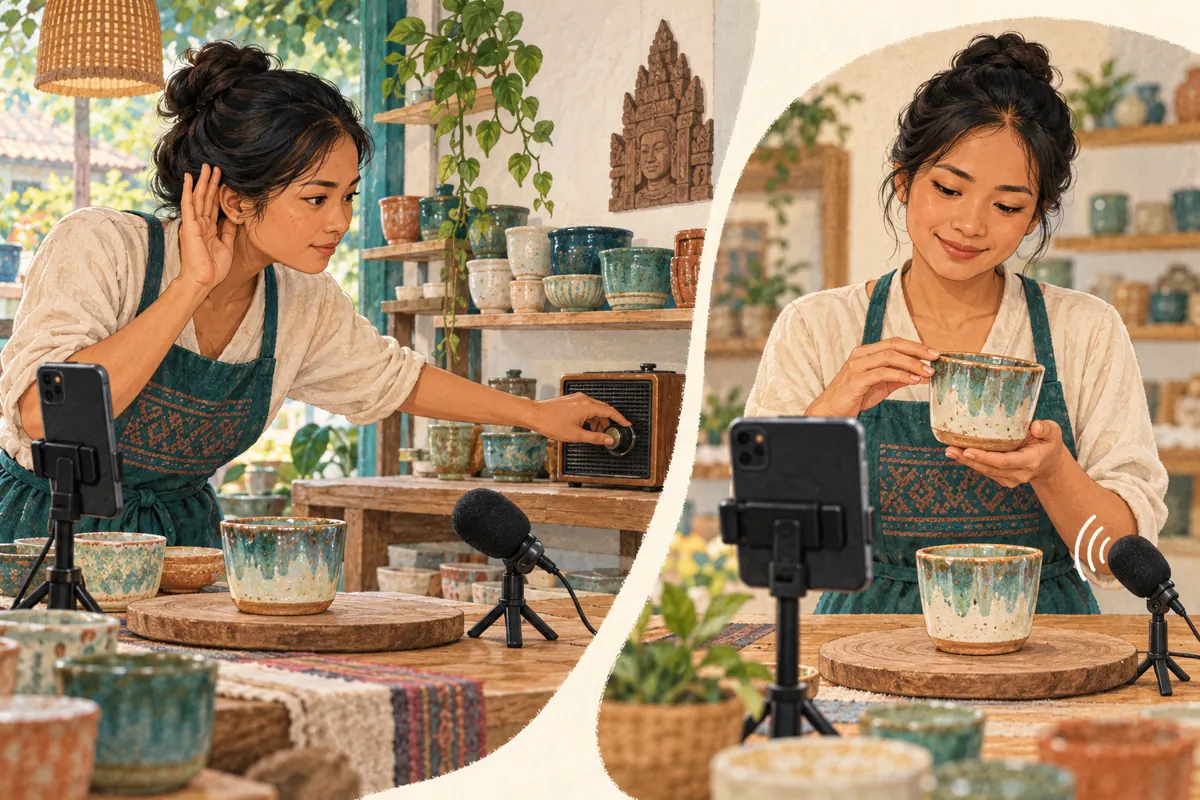
Review the raw clip with headphones. A shop radio, a nearby television or music from another phone may already be audible beneath the owner's voice. Adding a commercial track on top does not remove that existing recording. Identify unwanted sound while the filming setup is still available, because a clean second take may be simpler than repairing the audio later.
In the hypothetical shop, the owner switches off a radio and repeats the explanation beside the same cup display. The team also listens for distracting handling noise when the cup touches the saucer. Preserve useful natural sound if it helps viewers follow the demonstration, but avoid letting a sharp clink cover an important word. Keep the clean recording as a separate master so future versions can use different soundtracks without rebuilding the entire video.
5. Build the edit around the Khmer explanation
Place the complete spoken explanation first, then add music underneath it. Let the product movements follow the meaning: show the saucer when discussing the saucer, and show the available finish when describing its appearance. Do not shorten a qualifying sentence merely to land on a musical beat. If the offer is cup-only, that condition deserves the same clarity as the attractive product shot.
Test the mix through an ordinary phone speaker as well as headphones. A quiet office review can conceal problems that become obvious near a busy shop counter. Ask a Khmer-speaking colleague who did not edit the video to repeat the key condition. If they hesitate, lower or remove music around that sentence, simplify the delivery, or rerecord it. There is no universal volume percentage that guarantees intelligibility across different recordings, voices and tracks.
6. Keep a short soundtrack decision record
Create one note attached to the approved video version. Record the track title, artist or identifying reference, where it was selected, the intended region and placement, the review date, and the person who checked it. Also identify the clean master and the final edit. These details help another team member locate the actual selection instead of guessing from a remembered melody.
The note is a handover aid, not a licence created by the shop. If separate permission is involved, retain the relevant agreement and check that its scope matches the planned use. Avoid a vague entry such as music approved, which hides what was reviewed. A useful hypothetical entry would identify the cup demonstration, its Cambodian TikTok use, the selected track reference and any unresolved restriction. Unresolved items should remain visibly open before the team commits promotion spending.
7. Evaluate the SMM-panel proposal independently
The supplied boost-live.com catalogue includes the exact listing “TikTok - Likes ~ Bot Profiles ~ Max 5M ~ 100k/Days ~ Instant ~ 𝐍𝐎 𝗥𝗘𝗙𝗜𝗟𝗟”. Its category and title identify a likes service, but the brief supplies no supporting description. Treat the title's delivery language as catalogue wording, not verified performance. It provides no basis for claiming music clearance, Cambodian viewers, genuine interest, sales or official TikTok affiliation.
TikTok's official explanation of deceptive behaviour states that it does not allow fake engagement, including services that artificially increase likes or followers. A responsible review can therefore end with declining a proposed engagement purchase. Do not use a panel order to test whether a soundtrack is acceptable or whether customers want the cup. Music suitability, platform compliance and customer demand are separate questions; a larger displayed count cannot resolve any of them.

8. Approve each destination and version deliberately
A team may want to reuse the cup video on Facebook, Instagram or a shop website. Do not assume a TikTok soundtrack decision establishes permission for those destinations. Keep a clean export and check the music basis for each planned use. This also makes it easier to replace the soundtrack without losing the voice explanation or the careful product sequence.
Likewise, treat a later paid campaign as a fresh review point. Confirm the intended placement and current track suitability before using the edited video in that campaign. If a colleague sends an older copy, compare its sound and offer with the approved version rather than trusting the filename. In the hypothetical shop, a simple version note distinguishes the clean master, the TikTok edit and an unfinished cross-platform draft. That small distinction prevents accidental reuse of an unreviewed soundtrack.
9. Judge the result through meaningful questions
After publication by the authorised shop team, examine the questions people actually ask. Can they identify the cup? Do they understand whether the saucer is included? Are enquiries about colour, quantity or collection sufficiently clear for staff to answer? These observations help assess the explanation. They do not prove that music caused a purchase, and an absence of enquiries does not isolate music as the problem.
If people repeatedly misunderstand the offer, revisit the exact sentence and matching image before changing everything. For a future demonstration, keep a note of one deliberate creative change, such as removing music during the inclusion statement. Comparisons across different products and posting conditions remain imperfect. Record any paid promotion separately, and never present purchased engagement as Cambodian customer response. The practical objective is a clearer path from watching to asking an informed question.
10. Avoid shortcuts that create more work later
Common mistakes include choosing a trending track first, assuming an original-sound label establishes permission, forgetting music already captured in the shop, and approving the mix only through expensive headphones. Another is handing an editor a finished video with voice and music permanently mixed together. Preserve separate audio where practical so a soundtrack change does not force a complete rerecording.
Avoid rushing a replacement when a track becomes unavailable or a sound problem appears. Pause further promotion of the affected version, inspect the actual issue, and return to the clean master. A hurried new song may recreate the same uncertainty. Assign one person to approve the replacement and update the version note. The final check should cover both sound suitability and the buying information, because repairing music is not useful if the replacement edit accidentally removes the offer condition.

Frequently asked questions
Does an unpaid cup demonstration still need a commercial soundtrack review?
Yes. TikTok's business music guidance includes organic commercial content. Base the review on what the video does: a demonstration promoting the shop's products is commercial planning even without an advertising payment. Choose a suitable music route before editing tightly around a particular song.
What if the preferred song does not appear for the intended region?
Do not work around the missing option by selecting a different market. Choose another suitable track, use a clean spoken demonstration, or resolve the specific permission question before proceeding. Keeping a music-free master gives the shop a practical alternative while that question remains open.
Can a clear voice-only video be the final version?
Yes. Music is an editorial choice, not a requirement for explaining a cup. A clean voice recording with relevant natural sound can suit a detailed demonstration. Review pacing and clarity so the result feels intentional, and make sure essential offer information remains understandable when someone watches without sound.
Does paying an editor mean the shop can use every sound in the delivered video?
Do not assume that. Ask the editor to identify the music source and the basis for the intended use. Request a clean master as part of the handover. A production invoice explains what editing work was purchased; by itself, it does not explain the scope of music permissions.
Can panel likes show which soundtrack Cambodian buyers prefer?
No. Purchased likes do not establish the participants' location, listening behaviour or purchase intent. They cannot validate music rights either. For creative feedback, ask willing reviewers specific comprehension questions and examine genuine enquiries, while recognising that neither method proves a soundtrack caused sales.
Explore the current service catalogue, create an account, or ask a specific question through support tickets.
- TikTok Business Help Centre: About the Commercial Music Library
- TikTok Business Help Centre: How to use the Commercial Music Library
- TikTok Newsroom: How TikTok counters deceptive behaviour
Prepared with AI assistance. Illustrations explain the workflow and do not represent customer results.